Sales Pricing Manager
The Sales Pricing Manager Writeback template updates customer, customer price class, and base sales prices in Acumatica directly from a workbook. Use it for bulk price increases or decreases, promotional pricing, customer specific updates, margin impact review, and future dated price changes. It uses the NECWRITEBACK formula, generated with the Writeback Wizard, to send changes from your workbook back to Acumatica.
Select Initialize before editing prices. This creates a separate workbook copy with static data, so your work isn't lost on refresh.
Typical workflow
- Complete the sales price worksheet header, including the description and effective date.
- Use the filter fields to narrow the pricing records displayed in the grid.
- Select Initialize to create a working copy of the template.
- Select a cost basis and, when applicable, a warehouse for margin calculations.
- Enter a Price Increase % to apply a broad adjustment, or edit % Change and New Price directly on individual lines.
- Review the current margin, new margin, and overall margin summary.
- Confirm the effective date and any promotional expiration date for the updated lines.
- Review the validation summary and correct any errors or warnings that require attention.
- Select Push to Acumatica to create the sales price worksheet in Acumatica.
- After a successful writeback, use the populated reference number to open the worksheet in Acumatica.
- Select Reset before preparing another sales pricing update.
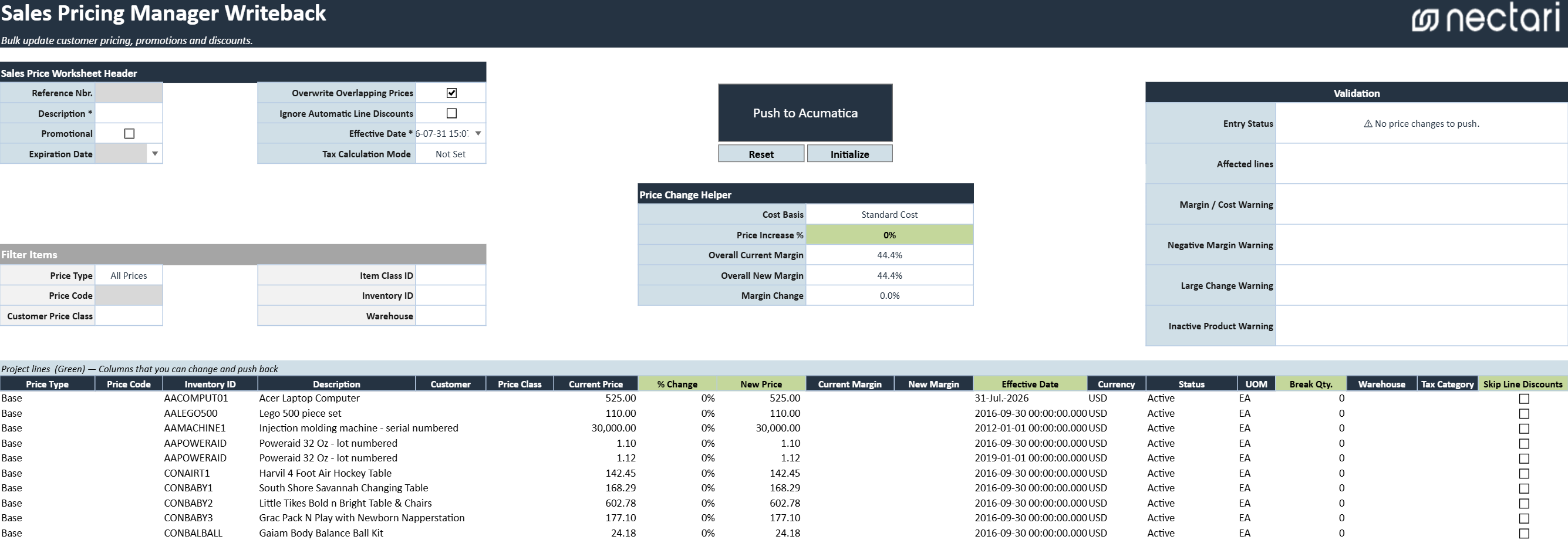
Worksheet header
Defines the Acumatica sales price worksheet and controls how the updated prices are processed. For promotional pricing, select Promotional and enter an Expiration Date later than the effective date.
| Field | What to select |
|---|---|
| Reference Nbr. | Reference number returned by Acumatica after a successful writeback. The populated value links to the created sales price worksheet. |
| Description * | Description of the sales price update or worksheet. |
| Promotional | Indicates that the worksheet contains promotional prices with a limited effective period. |
| Expiration Date | Date on which promotional prices expire. Required for promotional pricing and must be later than the effective date. |
| Overwrite Overlapping Prices | Allows existing sales prices with overlapping effective periods to be replaced when the worksheet is released. |
| Ignore Automatic Line Discounts | Prevents automatic line discounts from being applied to prices created from the worksheet. |
| Effective Date * | Default date on which the updated prices become effective. |
| Tax Calculation Mode | Determines whether prices are treated as tax inclusive or tax exclusive according to the selected Acumatica mode. |
Overwrite Overlapping Prices requires the sales price retention type in Acumatica AR Preferences to be configured as Fixed Number of Months.
Filters
Controls which existing sales price records are loaded into the pricing grid.
- Price Type: Filters records by price type, such as base, customer, or customer price class pricing.
- Price Code: Filters records by the applicable customer or customer price class code.
- Customer Price Class: Filters records for a specific customer price class.
- Item Class ID: Filters records by inventory item class.
- Inventory ID: Filters records for a specific inventory item.
- Warehouse: Filters warehouse specific pricing records and supplies the warehouse used by warehouse based margin cost calculations.
Writeback actions
| Action | What it does |
|---|---|
| Push to Acumatica | Validates the changed pricing lines and creates a sales price worksheet in Acumatica. A confirmation message indicates whether the writeback succeeded. |
| Initialize | Creates a separate workbook copy with (Initialized) added to the file name. Data extractions are disabled and the extracted pricing data is made static in this copy so it remains available while changes are being prepared. |
| Reset | Clears the current changes and restores the template to its last saved state. Any unsaved pricing edits are removed. |
Pricing grid
Displays the current sales prices and contains the values that can be updated. Columns shaded green are intended for user input. Only lines with a changed New Price or % Change are included in the writeback.
| Column | What it shows |
|---|---|
| Price Type | Type of sales price represented by the line. |
| Price Code | Customer or customer price class code associated with the price, when applicable. |
| Inventory ID | Inventory item whose sales price is being reviewed or updated. |
| Description | Description of the inventory item. |
| Customer | Customer associated with a customer specific price. |
| Price Class | Customer price class associated with the price. |
| Current Price | Existing sales price currently stored in Acumatica. |
| % Change | Percentage increase or decrease from the current price to the proposed new price. Editing this value recalculates New Price. |
| New Price | Proposed sales price to write back to Acumatica. Editing this value recalculates % Change. |
| Current Margin | Margin percentage based on the current price and selected cost basis. |
| New Margin | Margin percentage based on the proposed new price and selected cost basis. |
| Effective Date | Date on which the line's proposed price becomes effective. |
| Currency | Currency in which the sales price is defined. |
| Status | Current inventory item status. |
| UOM | Unit of measure to which the sales price applies. |
| Break Qty. | Minimum quantity required for the price to apply. |
| Warehouse | Warehouse associated with a warehouse specific sales price, when applicable. |
| Tax Category | Tax category associated with the price line. |
| Skip Line Discounts | Indicates that automatic line discounts should not be applied to the resulting price. |
Price change helpers
An overall view of the effect of the proposed pricing changes. Except for Price Increase %, these values are informational and are not written back to Acumatica.
- Cost Basis selects the cost source used to calculate current and new margins, such as standard, warehouse standard, warehouse average, or warehouse last cost.
- Price Increase % applies a percentage adjustment to the prices currently displayed in the grid.
- Overall Current Margin displays the combined margin percentage based on existing sales prices and the selected cost basis.
- Overall New Margin displays the combined margin percentage based on proposed new prices and the selected cost basis.
- Margin Change calculates the difference between the overall current and proposed margin percentages.
Review
Before writing back price changes:
- Confirm the Entry Status shows price changes are available to push, with no blocking errors.
- Check Affected Lines to confirm the expected number of records are included.
- Review any Margin / Cost Warning, where the selected cost basis is unavailable or a margin cannot be calculated.
- Review any Negative Margin Warning, where a proposed price would result in a negative margin.
- Review any Large Change Warning, where a price increase or decrease is unusually large.
- Review any Inactive Product Warning, where an updated price is associated with an inactive inventory item.
Warnings may not always prevent writeback, but each should be reviewed to confirm that the proposed pricing is intentional.